
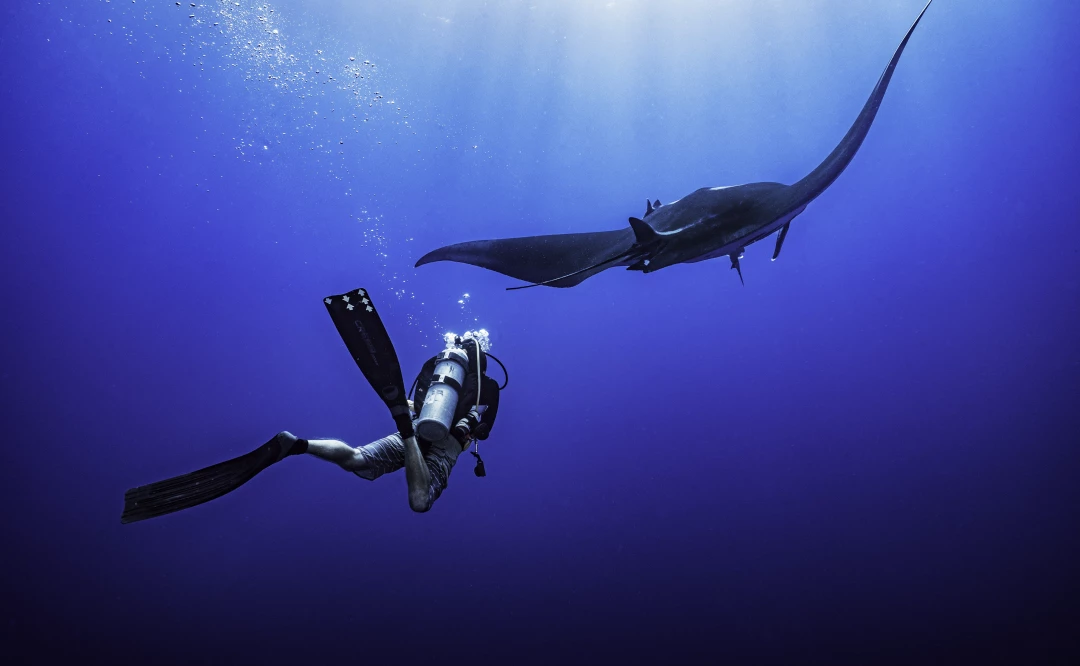
take your diving into the next level!
Do you want to explore wrecks, dive deeper, or refine your skills for more challenging environments?
The PADI Advanced Open Water Diver course is the next step for certified divers looking to broaden their experience and discover new dive sites. The course combines hands-on training with risk management to develop better judgment and greater independence underwater.
Through 5 dives, including confined and open water dives, you will progressively expand your skills. The course is designed to build confidence, improve your abilities, and give you greater independence as you take on new challenges underwater.
As a certified Open Water Diver, you have already mastered the essential foundations. The PADI Advanced Open Water Diver course takes your technical skills further and extends your maximum training depth to 30 meters (100 feet), opening the door to deeper dives, wrecks, and the diverse underwater environments of Mar de Cortés.
Advanced Oceanographic Conditions in La Paz
Deep diving requires a solid understanding of environmental conditions and precise dive planning.
visibility & temperature at depth
Thermal control is essential in deep diving. Water temperature can vary significantly with depth due to thermoclines. In La Paz, temperatures typically range from 19–22°C in winter and 25–30°C in summer, influencing wetsuit selection and overall dive planning.
| Season | Period | Water Temp | Suggested Exposure Suit |
| Winter | December – February | 19–22 °C (66–72 °F) | Full 5mm wetsuit |
| Spring | March – May | 20–24 °C (68–75 °F) | 3mm to 5mm wetsuit |
| Summer | June – September | 25–30 °C (77–86 °F) | 3mm wetsuit or shorty |
| Autumn / Fall | October – November | 24–29 °C (75–84 °F) | 3mm wetsuit or rashguard |
Advanced Current Dynamics: This course prepares you to dive at more demanding sites such as the Fang Ming and C-59, two wrecks in La Paz where moderate tidal currents may be present.
The same applies to El Bajo, an open-ocean seamount system known for variable currents ranging from moderate to strong. It is an ideal dive site for advanced divers looking to experience more challenging pelagic environments.
Advanced Training & Equipment
Your equipment becomes a tool for optimizing your performance underwater. The goal is to refine your technique and your handling of the tank, regulator, BCD, and weight system, with particular focus on buoyancy control to improve your hydrodynamic position.
Gas management is essential and requires constant monitoring of your pressure gauge. The deeper you dive, the higher your gas consumption will be.
You will also learn how to use a dive computer to accurately monitor and manage no-decompression limits at depths of up to 30 meters.
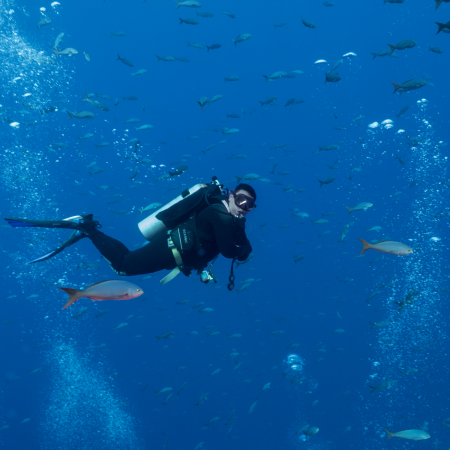
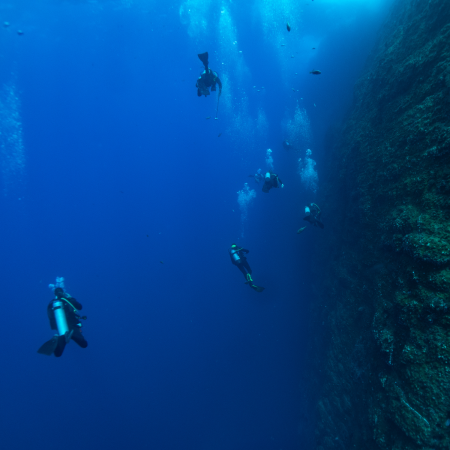
Itinerary
This course focuses on hands-on training, delivered over 2 days and 5 Adventure Dives, with no final theory exam.
Day 1 – Navigation & Specialty Dives:
You will complete the required Underwater Navigation Adventure Dive, where you will learn how to use a compass, estimate distance using kick cycles, and make use of natural navigation references. After this dive, you will complete 2 elective Adventure Dives of your choice.
Day 2 – Deep Diving:
The required Deep Adventure Dive includes exercises designed to demonstrate the effects of nitrogen narcosis, recognize physiological changes, manage gas consumption, and extend your training depth to 30 meters. Afterwards, you will complete 1 additional elective Adventure Dive.
Elective Adventure Dives:
Together with your instructor, you can choose from Peak Performance Buoyancy, Fish Identification, Underwater Naturalist, Wreck Diving, Search and Recovery, Underwater Photography, DSMB Deployment, and Enriched Air Nitrox.
Must have PADI Open Water certification and be at least 12 years old.
Advanced Open Water: Dive Sites Map (La Paz)
Interactive guide to deep reefs, historic shipwrecks, and open sea seamounts in Baja California Sur.
El Bajo Seamounts
An open ocean seamount system with moderate to strong variable currents. Ideal for experienced divers looking for pelagic fauna like schooling hammerhead sharks.
El Salvatierra Wreck
A 1976 shipwreck functioning as a massive artificial reef. Expect mild to moderate currents and encounters with large groupers and green moray eels.
Fang Ming Wreck
A 54-meter long sunken ship with mild currents, serving as an important refuge for marine life and sea turtles. Perfect for deep dive exploration.
C-59 Wreck
An artificial reef shipwreck. Requires good situational awareness due to mild to moderate tidal currents.
Los Islotes
An emblematic site with a significant California sea lion colony. Currents vary from mild to moderate depending on tides.
San Rafaelito Islet
A tranquil rocky islet protected from strong tides. Excellent for underwater navigation and peak performance buoyancy practice.
Swanne Reef
A shallow rocky reef located in the San Lorenzo Channel with variable currents. Great for fish identification and naturalist adventure dives.
Muelle Fiscal (Departure Point)
Official check-in at 09:00 AM on the La Paz waterfront malecón. Includes boarding our shaded panga boat and the daily advanced briefing.
Included
Scuba equipment.
5 dives.
E-learning materials.
Lunch.
Not Included
Alcoholic drinks.
You must bring
Ecofriendly sunscreen.
Swimsuit.
Biodiversity Profiles
(Pelagic & Deep-Water Fauna)
Advanced dive sites such as El Bajo and deeper wrecks open the door to a much more complex ecosystem:
Local expertise and the MTA Difference
Mexico Travel Adventure (MTA) believes your first dive should be much more than just an introduction. Our PADI Instructors are not only active diving professionals, but also marine biologists and naturalists with a passion for conservation.
Safety Policy: We operate with a maximum of 6 people per trip, ensuring personalized attention, continuous supervision, and greater respect for the marine environment.
FAQ´s
If you have any questions hopefully we can answer them below, if not please feel free to contact us.
Do I need a minimum number of logged dives to take this course?
No. You do not need to complete any additional dives beforehand. You can begin your Advanced Open Water Diver course immediately after completing your Open Water Diver certification.
What depth limit will I reach during this course?
The maximum depth limit for the Advanced Open Water Diver course is 30 meters (100 feet) for divers aged 15 and older.
For divers aged 12 to 14, the Junior Advanced Open Water Diver course allows a maximum depth of 21 meters (70 feet).
Is a final theory exam required?
No, there is no final exam. The course is highly practical and focuses on developing your underwater skills through 5 Adventure Dives and independent study with PADI eLearning.