Rise and fall of Gastón J. Vives’ pearl empire
The fascinating story of Espíritu Santo Island in La Paz
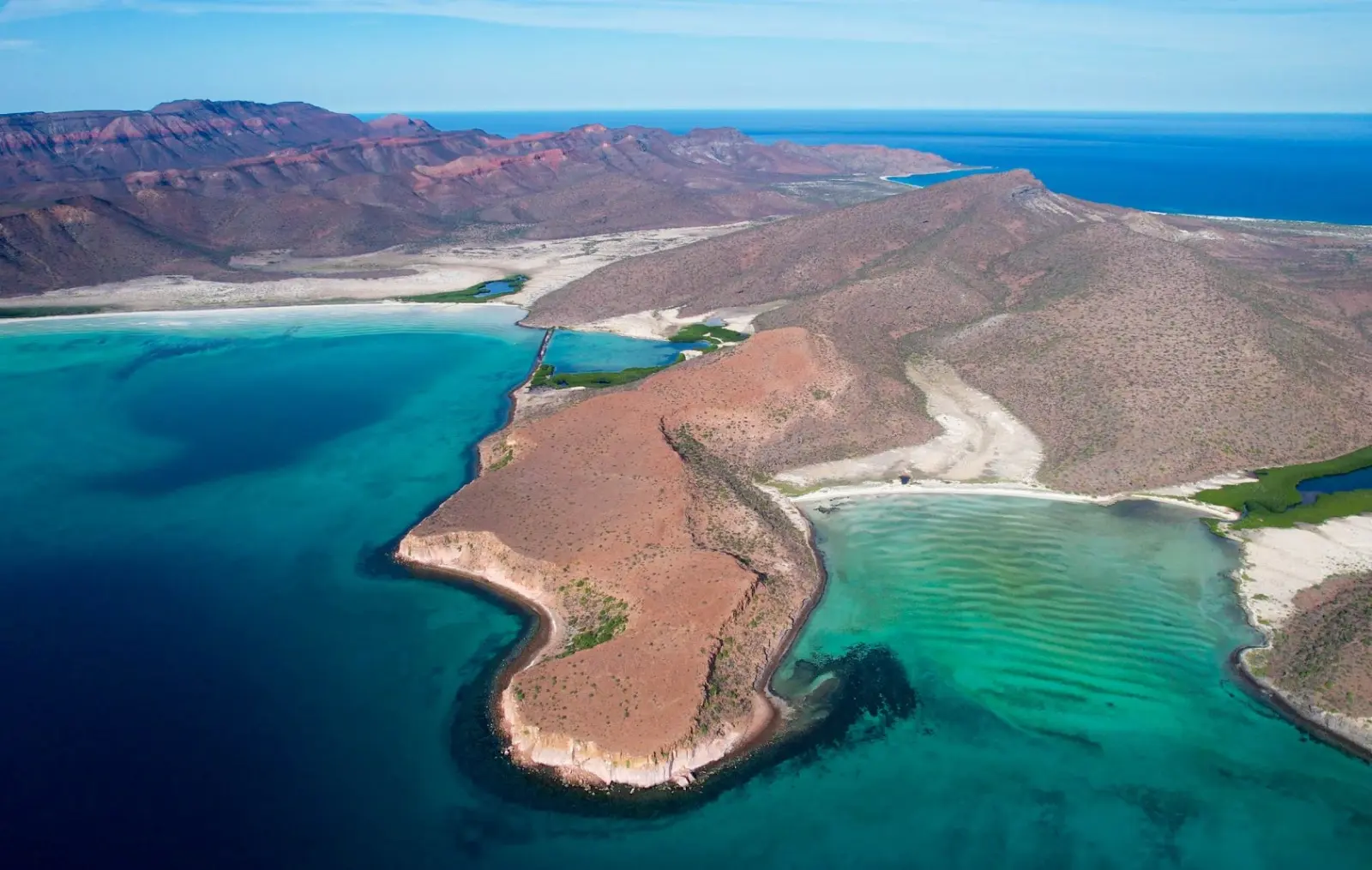
Espíritu Santo Island , a natural jewel in the Gulf of California , dazzles not only with its biodiversity but also with a fascinating yet little-known history .
For centuries, it was the scene of disputes, explorations, and dreams , fueled by the richness of its waters, which lay not only in their ecological value but also in the abundance of pearls that shimmered on its shores.
These marine treasures sparked a veritable frenzy that forever transformed the relationship between humankind and this natural sanctuary .
This is the story of how science, ambition, and politics shaped the island’s destiny, whose legacy still whispers among mangroves and frigatebirds .
The origin of the pearls of Espíritu Santo Island

The exploitation of pearl oysters began long before the arrival of Europeans to the Gulf.
The first inhabitants already used mother-of-pearl as ornamentation in 1532 , with the first expeditions, the island was named the “Island of Pearls” , and the surrounding area, the “Gulf of Pearls” .
Early commercial attempts
One of the pioneers in pearl farming was Manuel de Ocio , who in 1748 requested exclusive fishing rights on the island, obtaining a permit from the viceregal government.
However, the pearl boom was so intense that the natural pearl beds were depleted in just three decades , causing a pause of almost 50 years , which allowed for natural regeneration.
Gastón J. Vives and the rise of the pearl empire
In the mid-19th century, interest in pearls from the Gulf of California resurfaced thanks to scientific and technological advances in Europe.
It was in this context that the visionary figure of Gastón J. Vives emerged , combining knowledge, vision, and audacity .
From La Paz to Paris and back
Born in 1859 , Gastón J. Vives arrived in La Paz as a child , where he was raised by a French family.
At the age of 20, he traveled to Paris , where he studied biochemistry, aquaculture, and oyster farming .
Upon returning to Mexico, he became a key figure in local scientific and political life.
- Deputy for Mines
- Consular agent
- Municipal President of La Paz (1884–1914)
The Shell and Pearl Breeding Company (CCCP)
In 1903 , Vives founded the Shell and Pearl Breeding Company (CCCP) , with which he developed an innovative system for cultivating mother-of-pearl .
The project managed up to 10 million oysters , generating employment for 6% of the population of La Paz and strengthening the regional economy .
In the San Gabriel cove , southwest of the island, Vives built the world’s first great pearl emporium , with 36 nurseries interconnected by locks and a three-stage cultivation system that still amazes today for its precision and innovation .
South Californian pearls in the world
The pearls from Baja California Sur achieved international fame.
One of them, known as the “lemon pearl ,” was set in a crown belonging to the British royal family , supposedly to Queen Elizabeth II .
During a visit by the Queen to Mexico, the La Paz origin of the jewel was mentioned , a symbolic recognition of the excellence of Mexican pearls .
The decline of the pearl emporium of San Gabriel
As with every great success story, the rise brought its fall.
In 1914 , during the Mexican Revolution , and after leaving the mayoral office, Gastón J. Vives fell victim to political conflicts.
His rival, Miguel L. Cornejo , a regional political leader and opponent of Porfirio Díaz, ordered the destruction of the pearl fields of San Gabriel and confiscated his property.
This act marked the beginning of the decline of the pearl empire .
A legacy that lives on among mangroves
Today, the vestiges of that dream survive among mangroves and seabirds .
The 500-meter dike that Vives ordered built still forms an artificial lagoon , now home to a breeding colony of magnificent frigatebirds (Fregata magnificens) , with more than 3,000 individuals .
This colony, free of land predators, can be observed from authorized boats that tour San Gabriel Bay , offering visitors an unforgettable experience on Espíritu Santo Island .
Conservation, responsible tourism and a sustainable future
Without clear regulations, pearl harvesting continued for decades, until in 1939 the Executive Branch decreed a permanent ban on mother-of-pearl.
This led to a new phase of scientific research that culminated in the first modern large-scale cultivation in the 1980s .
In 1994 , the Pacific mother-of-pearl was included in NOM-059-ECOL-1994 as a species under special protection , a category that remains in force.

A symbol of ecological and cultural resilience
Today, Espíritu Santo Island in La Paz is a symbol of ecological and cultural resilience .
Its history reminds us that humanity’s desire for beauty can endanger nature, but also that science and conservation can reconcile both worlds.
Every frigate that takes flight and every visitor who hears its story keeps alive the memory of Gastón J. Vives and his legacy of ingenuity, splendor, and survival .
We invite you to discover this jewel of the Gulf of California and be part of its living history on a visit or tour to Espíritu Santo Island .