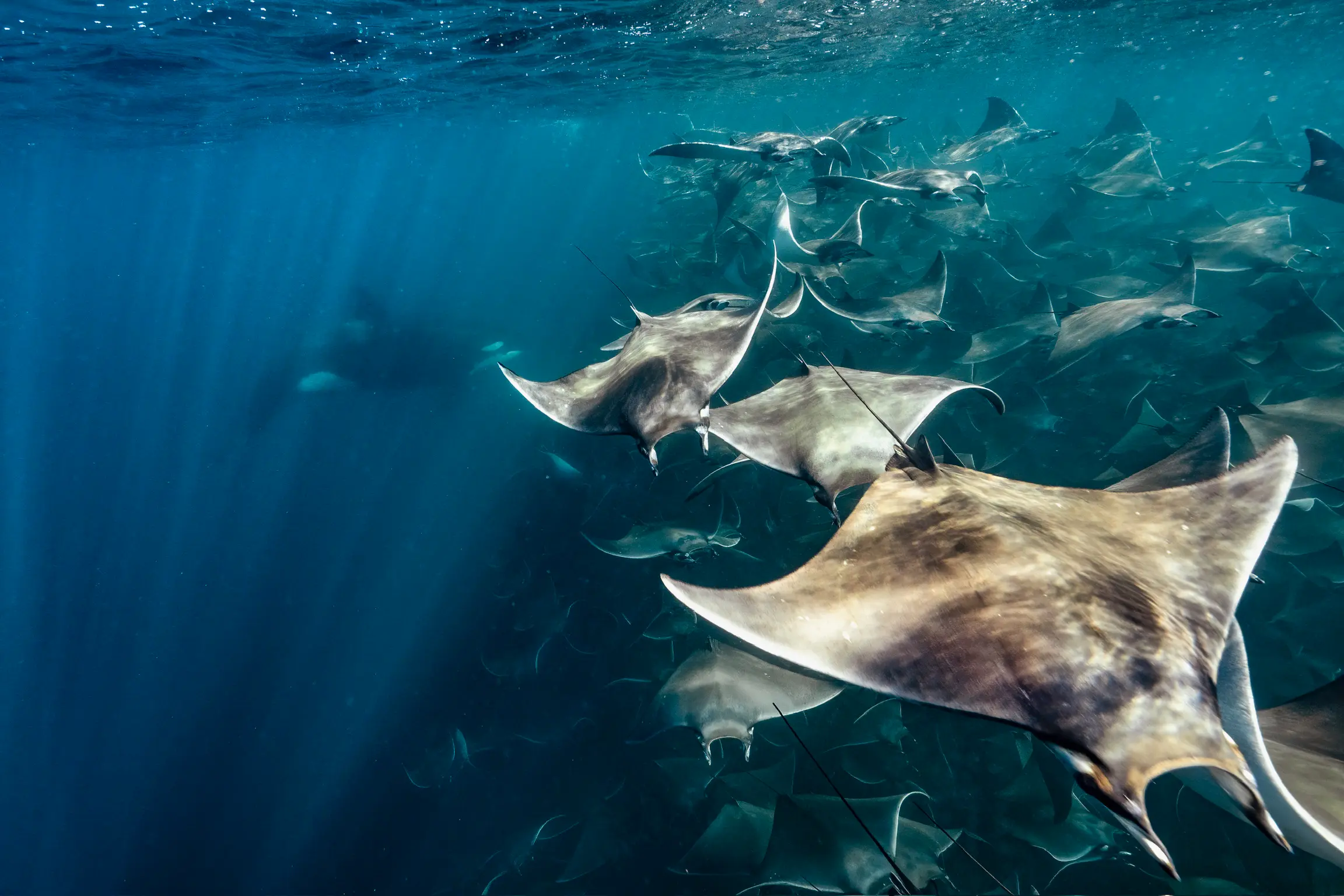
Every single year, thousands of eager travelers search the internet for tours promising to show them the massive aggregations of mobula rays in Baja. Unfortunately, a massive misconception dominates the tourism industry. Most visitors immediately book flights and hotels in Cabo San Lucas, assuming the famous arch marks the epicenter of this marine phenomenon. However, as experienced marine guides, we need to set the record straight right now.
Cabo San Lucas is an incredible destination for nightlife and resorts, but it is absolutely not the primary hub for this specific wildlife event. The massive aggregations—where you find tens of thousands of rays schooling together—actually happen much further north. The real action takes place deep inside the Sea of Cortez. Specifically, the massive fevers of rays congregate around the Cerralvo Channel and the coastal waters of La Ventana and La Paz.
When you book a generic tour out of Cabo, you are often signing up for a grueling, multi-hour bus ride on a bumpy highway just to reach the boats. You waste your absolute best morning hours sitting in traffic rather than scanning the horizon for wildlife.
Therefore, if you want to experience this natural wonder correctly, you must base your trip where the animals actually live. Booking directly with teams located at the source guarantees you maximize your time on the water.
Join our specialized mobula ray expedition and ensure you are exactly where you need to be at sunrise.
Oceanography and Seasonality: Why Do They Come Here?
To understand why this specific stretch of coastline acts as a magnet for marine life, we have to look beneath the surface. The Sea of Cortez is geographically unique. Deep, offshore oceanic trenches violently collide with shallow, sunlit coastal shelves right along the Baja peninsula. This dramatic underwater topography creates a perfect storm for marine biodiversity.
During the late spring and early summer months, intense solar radiation heats the surface of the ocean. Meanwhile, deep, incredibly cold currents push upward from the abyss, slamming into the coastal ridges. This violent mixing of water temperatures generates massive upwellings of nutrients. Consequently, these nutrients trigger explosive blooms of phytoplankton and zooplankton.
This plankton bloom essentially serves as an all-you-can-eat buffet for filter feeders. The rays migrate here by the millions to gorge themselves on this microscopic feast. Understanding this delicate biological clock is crucial for planning your trip.
The exact timing of the migration shifts slightly every year based on water temperatures and lunar cycles. Sightings typically begin in late March and continue through the end of June. However, if you want to witness the most massive schools, the peak window is generally from mid-May to mid-June. Interestingly, warmer oceanic years seem to yield fewer mobula rays overall.
Therefore, tracking the La Ventana mobula aggregation requires constant vigilance and daily scouting by experienced captains on the water.
The Snorkel Encounter: Sliding into the Blue
Spotting a massive fever of rays from the boat is thrilling, but slipping into the water with them changes your life forever. When our captains locate a massive school, they do not just rush the boat into the middle of the animals. Doing so instantly spooks the school, causing them to dive deep out of sight. Instead, we use a highly strategic, low-impact approach.
First, the captain positions the panga well ahead of the school’s projected path. We cut the engines entirely and let the ocean currents do the work. At this point, the guide will instruct you to prepare your gear silently. You must sit on the gunwale of the boat, fully equipped with your mask, snorkel, and fins, waiting for the precise signal.
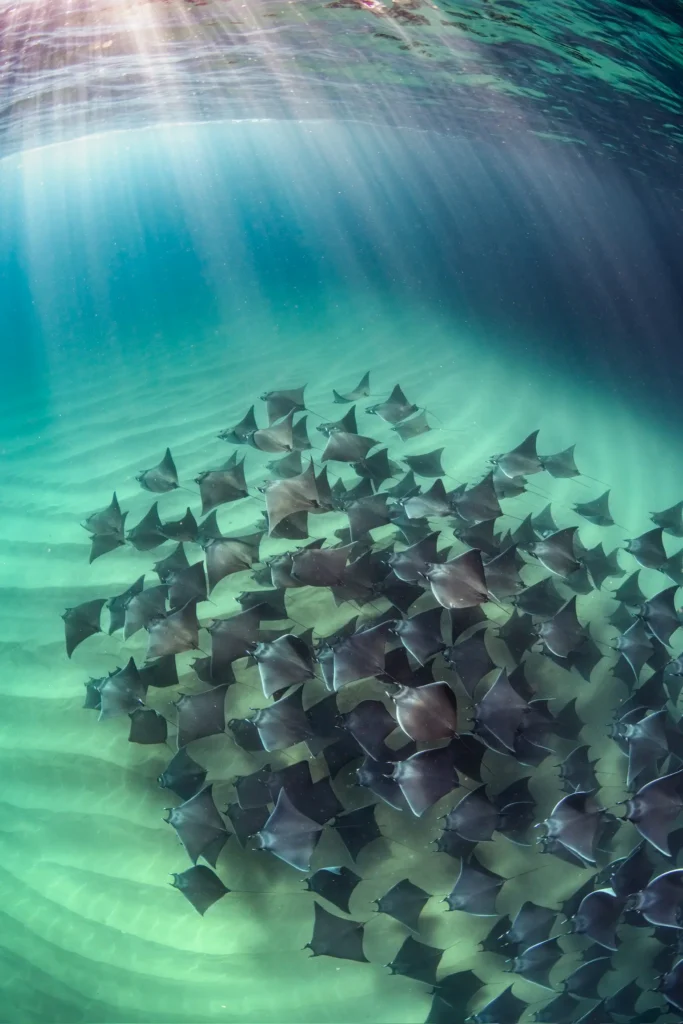
When the moment is right, you do not jump. Splashing violently into the water sends acoustic shockwaves straight down, which the rays interpret as a predator attack. Instead, you gently slide off the edge of the panga, keeping your fins submerged. Once your face hits the water, the sheer scale of the phenomenon hits you. You find yourself floating directly above thousands of Munk’s pygmy devil rays, moving together in perfect, synchronized harmony.
Water Conditions: Depth and Visibility
Normally, these encounters happen out in the deep blue without seeing the bottom, much like diving near Espiritu Santo Island. Occasionally, when the schools move very close to the coast—such as near El Faro de Punta Arena or Ensenada de Muertos (Bahía de los Sueños)—the ocean floor becomes visible.
Underwater visibility typically ranges between 8 and 20 meters (26 to 65 feet). While we usually spot the rays at a depth of about 10 meters (33 feet), during the best seasons, they swim as shallow as 4 meters (13 feet) or even glide right at the surface.
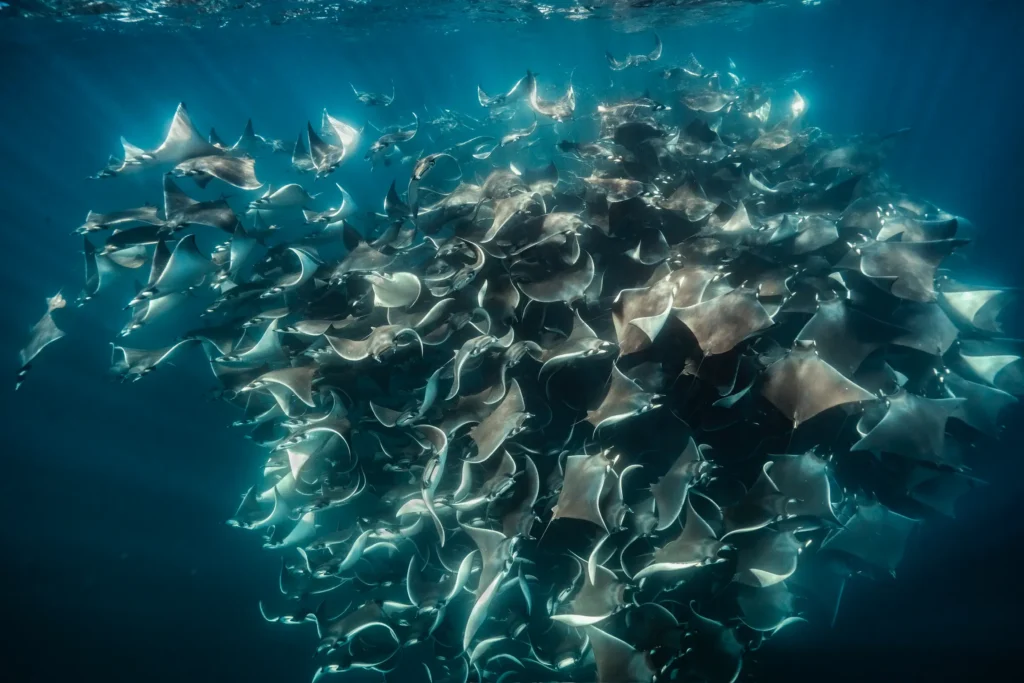
The visual is truly staggering. They stack on top of one another, creating massive underwater clouds that block out the sunlight plunging into the depths. This type of high-level Sea of Cortez snorkeling requires you to stay calm, float completely flat on the surface, and let the animals pass harmlessly beneath your chest.
The Mobula Ballet: Decoding the Acrobatics
Long before you see the rays swimming underwater, you will hear them from the boat. As you cruise through the channel, the ocean suddenly sounds like a giant bowl of popping popcorn. This noise comes from hundreds of rays launching themselves out of the water and belly-flopping violently onto the surface.
Witnessing this aerial display is mesmerizing. A single ray will breach the surface, flap its wing-like pectoral fins rapidly, catch up to ten feet of air, and then slam down onto the ocean. But why exactly do they expend so much precious energy doing this? Marine biologists currently debate three primary theories regarding this intense acrobatic behavior.
First, the loud smacks serve as a form of acoustic communication. In the vast, open ocean, a loud surface slap echoes for miles underwater, potentially calling distant, scattered rays to join the massive feeding aggregation. Second, the impact might help dislodge irritating parasites clinging to their rough skin. Finally, the most compelling theory suggests the jumping is deeply tied to courtship displays. The highest jumpers creating the loudest splashes might be demonstrating their superior physical fitness to potential mates.
Regardless of the scientific reason, sitting on a boat surrounded by leaping rays is wildly entertaining. You can spend hours just watching the horizon explode with splashing water in every direction.
Apex Predators and the Food Chain
You must always remember that the Sea of Cortez is a wild, untamed wilderness, not a controlled aquarium. When you pack tens of thousands of rays into one centralized location, you inevitably attract the heavy hitters of the ocean. Massive schools of prey serve as a dinner bell for some of the most formidable marine predators on the planet.
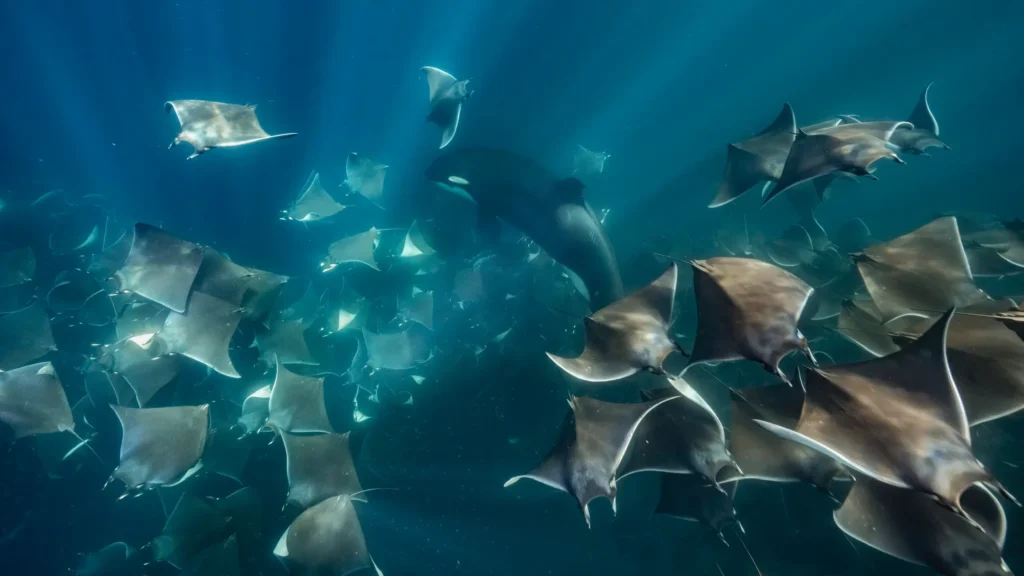
Consequently, our expeditions often encounter incredible, entirely unscripted wildlife events. The Cerralvo Channel wildlife corridor frequently hosts hunting pods of Eastern Tropical Pacific (ETP) Orcas. These highly intelligent killer whales specifically migrate into the gulf to hunt the rays.
When the orcas arrive, the energy in the water completely shifts. The rays bunch up defensively, and the orcas execute highly coordinated, tactical strikes to stun their prey. Sharing the water during these hunting events is the absolute pinnacle of marine observation. To safely witness these chaotic, high-adrenaline moments, you need an elite crew that understands predator behavior. Riding with guides who know exactly how to position the boat safely ensures you get the ultimate view without interfering. [Enlace a: /en/offer/orca-mobula-ray-expedition/]
The Ethical Code of Conduct
Because this environment is so fragile, strict rules of engagement are absolutely mandatory. Ethical operators prioritize the well-being of the animals above all human desires. The first and most critical rule is simple: absolute zero physical contact. You must never reach out and attempt to touch a passing ray. Touching them removes the protective mucous layer on their skin, instantly exposing them to deadly bacterial infections.
Furthermore, we strictly regulate freediving behavior during these encounters. Aggressively diving down directly into the center of a dense fever will instantly split the school apart. This selfish behavior ruins the natural schooling dynamics and destroys the viewing opportunity for everyone else in the water. Instead, ethical freedivers swim carefully to the outer perimeter of the school, dropping down parallel to the animals without breaking their formation.
Finally, chemical pollution represents a massive, invisible threat to filter feeders. Because these rays constantly filter seawater through their gills to breathe and eat, toxic sunscreen chemicals cause severe internal damage. Therefore, we strictly enforce the use of specialized rash guards for sun protection, permitting only certified reef-safe sunscreens on exposed skin.
By following these fundamental rules, we guarantee that our presence remains passive and respectful. Swimming with mobulas is a rare, life-altering privilege, and it is our collective responsibility to protect this phenomenon for future generations. Choose your operator wisely, respect the wild, and prepare yourself for the most dynamic ocean safari in North America.
Don’t settle for long bus rides from Cabo San Lucas. Launch directly into the heart of the mobula aggregation from our La Paz and La Ventana bases. Explore our Mobula Ray Ocean Safari.