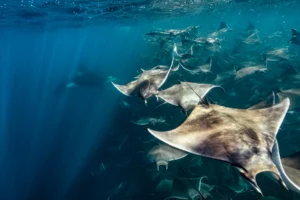

In the crystal-clear waters of the Gulf of California, a natural spectacle unfolds each year, as mysterious as it is breathtaking. Thousands of mobula rays emerge from the deep blue to star in one of the ocean’s most impressive events.
With their fleeting flights and hypnotic movements, these winged rays transform the sea into a vibrant stage where beauty, survival, and wonder intertwine.
What are mobulae?
Mobula rays belong to the group of elasmobranchs , one of the oldest branches of the marine kingdom. This group also includes:
- Sharks
- Stripes
- Chimeras
They all share a flexible cartilage skeleton and gills that are highly efficient at extracting oxygen from the water.

Mobula species in the Gulf of California
To date, five species of mobula rays have been recorded in the Gulf of California:
- Mobula munkiana
- Mobula mobular
- Mobula thurstoni
- Mobula birostris
- Mobula tarapacana
The first three are the most common in sightings in La Paz and La Ventana , especially between March and August , although with slight variations depending on the species.
Migration and seasonal behavior
Unlike other marine animals, mobula rays do not stay in one place .
Their distribution covers much of the eastern tropical Pacific , and their movements depend on factors such as:
- Water temperature
- Food availability
- Reproductive cycles
Every year they return to the temperate bays of Baja California Sur , guided by a kind of internal compass.
Thanks to recent photo-identification and telemetry studies , scientists are beginning to understand their migratory routes and aggregation patterns.

Mobula munkiana: the star of the Gulf
Among all the species, Mobula munkiana , also known as the “Pacific ray ,” is the most emblematic.
During spring and summer , thousands of specimens congregate in areas such as:
- La Paz
- The Window
- Espíritu Santo and San José Islands
This phenomenon marks the beginning of the mobula zoant season .
The jump spectacle: a dance of survival

During this time, mobulas perform jumps, turns, and synchronized movements that defy all logic.
These behaviors are related to:
- Nutrition
- Reproduction
- And, possibly, communication between individuals
Visitors can enjoy this natural spectacle from boats, while snorkeling, or with drones , which capture spectacular aerial views of the silver swarms .
Mating trains: an underwater dance
One of the most fascinating behaviors is that of the so-called “mating trains . “
During these:
- A female leads the march
- Several males follow her in perfect synchronicity
- They compete to achieve copulation
This strategy increases the chances of reproduction and also reduces the risk of predator attacks, thanks to the cohesion of the group.
Natural predators: the role of orcas
During the breeding season, mobula rays face one of the ocean’s most intelligent predators : killer whales .
These cetaceans, with their almost global distribution, frequent the coasts of the Gulf of California precisely when the mobula rays congregate.
In places like La Paz and La Ventana , orcas take advantage of the abundance of rays as a food source .
Their hunting technique includes:
- Tail swipes to stun
- Coordinated group attacks
- And tactics of pushing towards the seabed

A meeting between ocean giants
The confrontation between orcas and mobula rays is a display of strategy, speed, and coordination .
While the orcas attempt to isolate individuals , the mobula rays regroup to confuse their attackers, creating dense, silvery clouds in the water column.
This phenomenon reveals both the intelligence and cooperation of the orcas , and the resilience and adaptability of the mobulas.
Conclusion: a unique natural spectacle
The sighting of mobula rays in the Gulf of California is one of the most impressive marine events in the world .
Witnessing it not only allows one to contemplate the ocean’s biodiversity , but also to reflect on the delicate balance between predators, prey, and ecosystems .
If you visit Baja California Sur between March and August, don’t miss the opportunity to experience this natural spectacle that unites science, nature, and wonder.